
August 28, 2026 · 7-min read
Death Announcement Letter Wording for Family, With Examples
The right words, in the right order, make a hard letter easier to write and easier to receive.
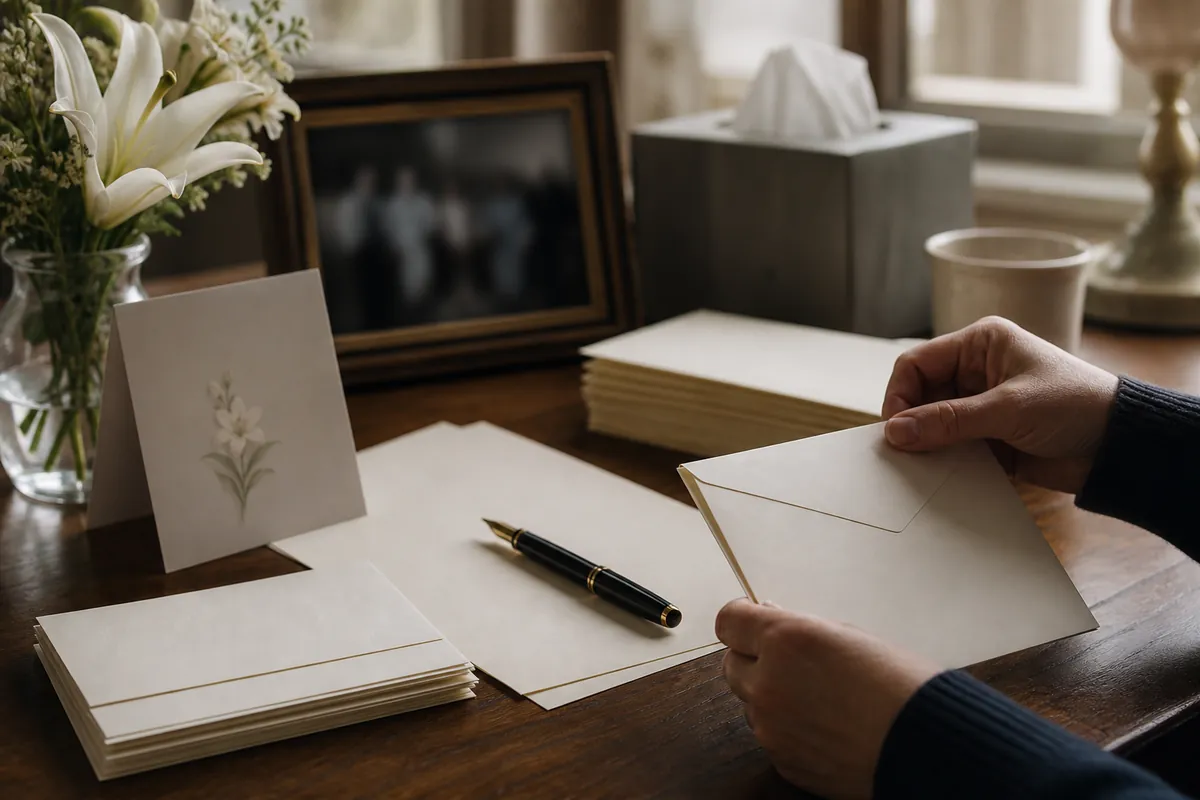
A death announcement letter should open by stating, plainly, who died and when, in the first sentence, followed by how the reader knew them and whatever service details you have so far. Keep it short. The letter's job is to deliver the news clearly and kindly, not to tell the whole story.
Mailing a letter, rather than sending a text or a group email, is often the right choice for older relatives, distant family, or anyone you want to reach in a quieter, more considered way. It gives the person a private moment to sit with the news, rather than reading it between other messages on a phone.
What Should the First Sentence Say?
Lead with the fact, not a preamble. Readers scanning a mailed letter want the news right away, not three lines of throat-clearing before they learn what happened.
A first sentence that works does three things at once:
- Names the person who died
- Gives the date, or "recently" if the letter is going out quickly
- States the relationship to the writer, if it is not obvious from the letter's return address
For example: "I am writing to let you know that my mother, Helen Marie Cooper, passed away on August 14, 2026, at her home in Springfield."
What Information Belongs in the Letter?
Beyond the opening sentence, a death announcement letter usually covers a small, predictable set of details. You do not need to include all of them, only the ones that are settled and true.
- Full name, and any name the recipient would recognize (a maiden name, a nickname)
- Age, if the family wants it included
- Date and place of death, in general terms
- Service date, time, and location, or a note that arrangements are pending
- Whether the service is private, family-only, or open to all who wish to attend
- Where to send flowers, cards, or a memorial donation, if decided
- A closing line naming who is sending the letter, and how to reach them with questions
Leave out anything the family has not yet agreed on. It is easier to mail a short follow-up note than to correct a detail that was wrong the first time.
How Do I Word It for a Sudden or Unexpected Death?
When the death was sudden, the letter can stay just as brief. There is no need to explain what happened in detail, and most families prefer not to.
A simple, honest line is enough: "It is with heavy hearts that we share the sudden passing of my brother, James Alan Reed, on August 20, 2026." You can add "unexpectedly" or "suddenly" if it helps recipients understand why the news feels abrupt, without going further than that.
If you are also writing a printed program for the service itself, our guide on wording a funeral program after a sudden or unexpected death covers that piece separately, since it usually needs a slightly different tone than the mailed letter.
Sample Death Announcement Letters You Can Copy
Use any of these as a starting point, and adjust the names, dates, and details to fit.
A standard letter, service confirmed:
"Dear family and friends, I am writing to share the news that my father, Robert Lee Hastings, passed away peacefully on August 10, 2026, at age 82. A memorial service will be held on August 24, 2026, at 11:00 a.m. at Grace Community Church, 400 Oak Street, Springfield. In lieu of flowers, the family asks that donations be made to the Springfield Animal Shelter. Please reach out to me at (555) 123-4567 with any questions. With love, Sarah Hastings Blake"
A shorter letter, service pending:
"I am sad to tell you that my aunt, Linda Marie Torres, passed away on August 18, 2026. Service details are still being arranged, and I will send a follow-up note as soon as they are confirmed. Thank you for your love and support during this time."
A letter for a private, family-only service:
"With a heavy heart, I am writing to let you know that my husband, Thomas Wayne Ellis, passed away on August 21, 2026. The service will be private, for immediate family only, but we welcome cards and messages of remembrance, which can be sent to our home address above."
How Do I Mention Service Details Without a Date Yet?
It is common to need to mail the letter before every detail is settled. In that case, say so plainly rather than leaving the reader guessing.
A line like "Service arrangements are being finalized and will be shared separately" tells the recipient exactly where things stand. You can follow up later with a short card, a phone call, or a link to the funeral home's website once the date is confirmed.
What Tone Should I Use?
Write the way you would speak to the person if you were telling them in the room. Plain, warm, and unhurried works better than formal or flowery language, which can feel distant on the page.
A few small choices help the tone land gently:
- Use the person's full name once near the top, then a shorter form afterward
- Avoid euphemisms that might confuse an older relative, but soften language where it feels right ("passed away" rather than a blunter phrase)
- Keep sentences short, especially in the opening lines
- Sign with your own name and relationship, so the recipient knows who is writing
Who Should Receive a Mailed Letter vs a Text or Email?
A mailed letter tends to suit relatives who live at a distance, older family members, or anyone you want to reach without the immediacy of a phone or a screen. For closer contacts you will speak with directly, or for people who need the news faster, a different format may fit better. Our guide on wording a funeral announcement to send by text or email covers that shorter, faster version of the same news.
How Do I Close the Letter?
End with your name, your relationship to the person who died, and a way to reach you if the recipient has questions or wants to send a card. A short line of thanks for their love or support closes the letter warmly without needing anything more.
Once the service date is set, many families also put together a printed program for the day itself. If you are at that stage, our Funeral Planning Guide includes a service outline and guest information pages to fill in, so you are not starting that piece from a blank page too. You can browse the full range of printable templates in the shop if you are planning other parts of the service at the same time.
Frequently asked questions
- How soon should I mail a death announcement letter after someone dies?
- Most families mail it within a week or two, once the service date is set or it is clear one will take some time to arrange. It is fine to send the letter even if only a few details are confirmed.
- Is it rude to mail a death announcement instead of calling?
- No. A mailed letter is a long-standing, respectful way to reach relatives who live far away or who you want to give a quiet, private moment to read the news rather than take a sudden phone call.
- Should I mention the cause of death in the letter?
- Only if the family is comfortable sharing it. Many letters simply state that the person died, or use a gentle phrase like 'after a long illness,' with no further detail required.
- What if I do not know the funeral date yet when I need to mail the letter?
- Send the letter with the news itself and note that service details will follow by phone, a second card, or an obituary link, so relatives are not left waiting on the letter alone.
- Can I send the same letter to everyone on my list?
- Yes. One well-worded letter, adjusted only in the greeting line, works for most of your mailing list. Save a more personal note for a very small number of especially close relatives if you have the time.
- death announcement
- letter wording
- funeral etiquette
- grief support
- announcements
Related reading
- How to Choose Funeral Flowers When You Don't Know the ProtocolNot sure what flowers to send for a funeral? Here is a simple, honest guide to type, color, size, and timing for any relationship.
- What to Wear to a Funeral When You Don't Own BlackWhat to wear to a funeral if you don't have black clothes: stick to dark, muted, solid colors like navy, gray, or deep brown.
- What to Bring to a Funeral: A Respectful GuideWondering what to bring to a funeral? This gentle guide explains thoughtful, practical ways to support a grieving family.