
November 11, 2026 · 7-min read
How to Plan a Memorial Service When There's No Body
There is no casket to gather around, but that does not mean there is nothing to hold onto.

When there's no body, a memorial service still works. You gather people, you honor the person's life, and you use symbols, stories, and shared memory in place of a casket or urn.
This situation is more common than you might think. It happens after a death at sea, a disappearance, a donation to medical science, a disaster where remains are not recovered, or a death and cremation that occurred far from home. Whatever brought you here, you are not doing this wrong. There is no rulebook that says a service needs a body to be real, meaningful, or enough.
What is a memorial service without remains?
A memorial service without remains is a gathering focused entirely on the person's life rather than on burial or cremation. There is no casket, no urn, and often no formal viewing.
Instead, the service centers on:
- Stories and tributes from people who knew them
- Photos, music, and personal items that represent who they were
- A symbolic focal point, such as a photo, candle, or small display, in place of a casket
Funeral homes sometimes call this a "memorial service" specifically to distinguish it from a funeral, which traditionally involves the body present. You can hold one in a funeral home, a church, a backyard, a park, or anywhere that feels right.

How do I create a focal point without a casket?
Most services, even simple ones, benefit from having one visual center that draws the eye and gives people somewhere to direct their grief. Without a body present, you get to choose that focal point yourself.
Common options include:
- A large, clear photograph on an easel or stand
- A small table with meaningful objects: a favorite hat, tools, books, instruments
- Flowers arranged around a framed image
- A memory table where guests can add their own photos or notes as they arrive
- A candle that stays lit for the duration of the service
Keep it simple. One well-chosen photo often carries more weight than a cluttered display.
What should the order of service include?
The structure of a memorial service without a body looks much like any other, just without the elements tied to the casket, such as a procession or committal. A workable order often looks like this:
- Welcome and opening words from an officiant, family member, or friend
- A reading or prayer, if that fits your family's beliefs
- Stories and tributes from two to four people who knew them well
- A moment of music, either live or recorded
- A time of shared silence or reflection
- Closing words, often including what happens next (a reception, a tree planting, a release of some kind)
If you want a fuller breakdown of timing and structure, our guide on how to plan a graveside service covers pacing and wording that translates well even without a burial.
What can we do instead of a burial or scattering?
Without remains, there is often a natural pull to create some kind of closing ritual, something physical that marks the moment. You do not need ashes or a body to do this.
Ideas that work well:
- Planting a tree or shrub in their memory, at home or in a dedicated memorial garden
- Releasing something biodegradable, such as paper lanterns, flower petals into water, or seed paper
- Writing letters that are read aloud, then kept, burned safely, or buried in a memory box
- Lighting candles one at a time as names or memories are shared
- Creating a memorial bench, plaque, or stone that the family can visit, even without remains buried there
Pick one. A single ritual, done with intention, means more than several done quickly.
How do we word the invitation or program?
People often freeze when it comes to wording, worried that mentioning "no body" feels blunt or that avoiding it feels dishonest. A little clarity helps guests know what to expect.
For the invitation, something like:
"We invite you to join us in celebrating the life of [Name]. This will be a memorial gathering, as [his/her/their] remains were not recovered. We will share stories, music, and time together in [his/her/their] honor."
For the program or order of service, a simple line works:
"Today we gather not to say goodbye to a body, but to celebrate a life that touched each of us."
You do not need to explain the circumstances in detail unless you want to. Guests generally take their cue from the tone the family sets.

How do I help guests who aren't sure what to expect?
Some guests may have only attended traditional funerals before and feel unsure how to act without a casket or viewing in front of them.
A few small things ease this:
- Mention the format briefly in the invitation, as shown above
- Have greeters or family members near the entrance to guide people to seating
- Set up the memory table or photo display somewhere visible on arrival, so people have something to look at and gather around
- Let the officiant or host acknowledge the format in the opening words, so nobody is left guessing
Once people understand the shape of the service, they settle into it quickly. Grief finds its way regardless of whether there is a body in the room.
What about religious or cultural expectations?
Some faiths have specific requirements around burial and the body that may feel unresolved when remains are not present. If this applies to your family, it is worth a conversation with clergy or a spiritual leader about what adaptations are possible, and what blessing or ritual can stand in for a traditional rite.
If your family is not religious, or the person who died was not, you have more flexibility to build the service around their personality and values rather than ceremony. Our post on planning a funeral when the person had no religion has more on shaping a secular service that still feels complete.
Where can I find help putting it all together?
Planning any service while grieving is hard. Planning one without a body often means doing it with less guidance from a funeral home, since there may be no casket or burial logistics pulling the day into a familiar shape.
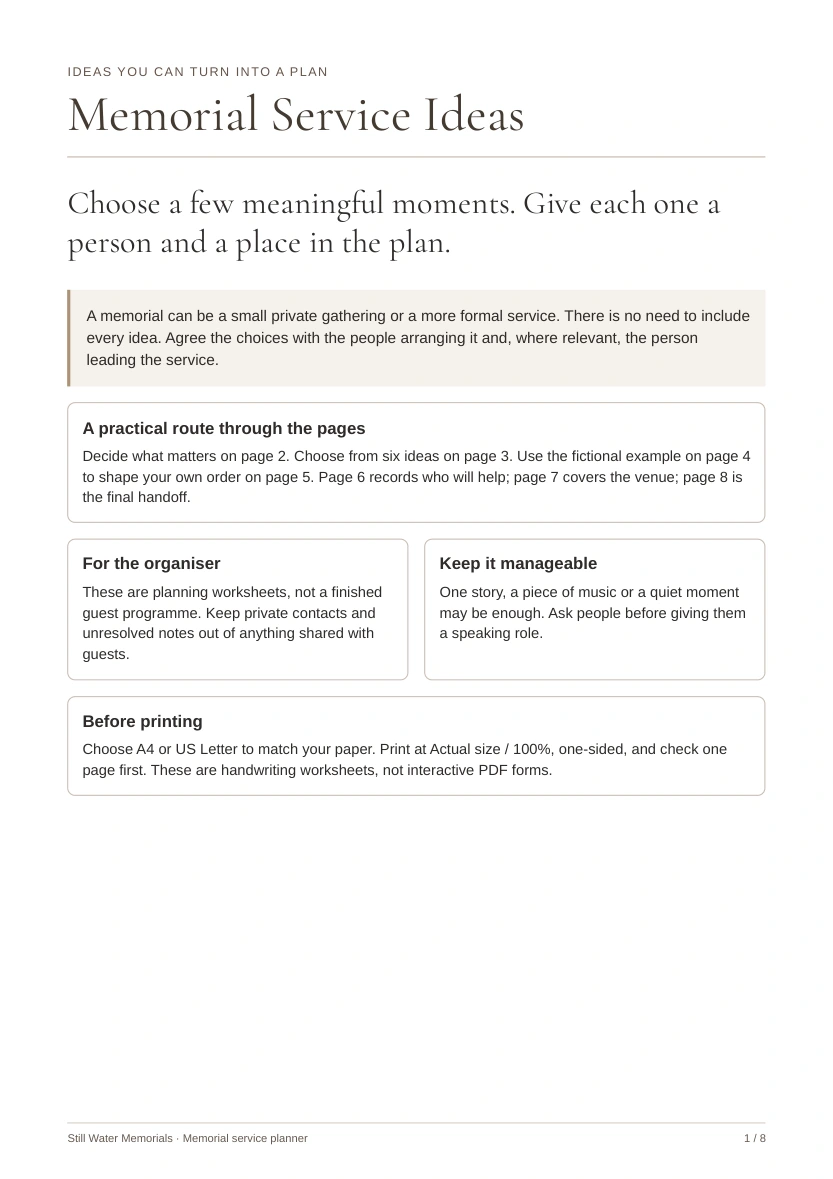
If you want a starting point for structure, readings, and wording ideas, our Memorial Service Ideas guide walks through options for services like this one, so you are not starting from a blank page. You can also browse the full shop for programs, prayer cards, and other printables if you decide to hold a more formal gathering later.
There is no single right way to say goodbye to someone whose body is not there to say goodbye to. What matters is that the people who loved them had a place and a time to do it together.
A printable to help
Frequently asked questions
- Is it still called a memorial service if there are no remains?
- Yes. A memorial service is simply a gathering to honor someone's life, with or without remains present. A funeral traditionally involves the body, while a memorial service does not require it.
- How long after a death without recovered remains should we wait to hold a service?
- There is no set rule. Some families hold a service within weeks, especially if a search has been called off or a cause of death is confirmed. Others wait months, particularly if there is a legal process or a small chance of recovery. Do what feels right for your family and your timeline.
- Can we still have a viewing or visitation without a body?
- Not in the traditional sense, but you can create a similar gathering space with photos, belongings, and a memory table where people can sit with the loss before the formal service begins.
- What do we put in the obituary if there was no funeral home involved?
- You can write and place the obituary yourselves, through a local newspaper or online, without a funeral home. Focus on the person's life, the people who loved them, and details of the memorial service rather than burial arrangements.
- memorial planning
- no body
- lost at sea
- donated to science
- memorial service ideas
Related reading
- How to Word a Funeral Invitation for a Celebration of LifeClear celebration of life invitation wording examples, plus a simple template covering tone, details, and dress code for a personal gathering.
- What to Do With a Loved One's Ashes: Options Beyond BurialA gentle, practical guide to what to do with a loved one's ashes, from keeping them at home to scattering, sharing, and simple memorial keepsakes.
- Celebration of Life Ideas: Planning a Service That Feels Like ThemCelebration of life ideas to plan a personal, meaningful service: themes, music, photos, keepsakes, and simple wording you can use right away.