
November 9, 2026 · 8-min read
How to Plan a Funeral When the Person Had No Religion
You don't need a faith to give someone a meaningful goodbye. You just need structure, honesty, and the right words.

If someone had no religion, you can still plan a full, meaningful funeral by building the service around their life instead of a faith tradition. That means choosing your own structure, your own readings, and your own way of marking the moment, with no scripture or clergy required.
This can feel harder than following a religious template, simply because there isn't one. But a secular service can be just as rich, and often feels more personal, because every piece of it is chosen specifically for the person you lost.
What does a funeral with no religion actually look like?
A nonreligious funeral or memorial still has a beginning, middle, and end. It just fills that shape with the person's life rather than doctrine.
A typical structure might include:
- A welcome or opening words from whoever is leading
- A brief life story or timeline, shared by family or a celebrant
- One or two readings, songs, or pieces of music
- A eulogy or several short tributes from different people
- A moment of silence or quiet reflection
- Closing words and information about what happens next (burial, reception, etc.)
Nothing here requires faith language. You can call it a funeral, a memorial, or a celebration of life, whichever word feels right to your family.
Who should lead the service if there's no clergy?
Someone still needs to guide the room, even without a religious officiant. This person keeps the order moving, introduces speakers, and holds the space when emotions run high.
Options include:
- A close family member or friend, especially one who is steady under pressure and comfortable speaking in public
- A funeral director, many of whom lead secular services regularly
- A professional secular or civil celebrant, who can help write and run the entire ceremony
- Two people sharing the role, so no one carries the whole weight alone
If you're choosing a family member, pick someone who can stay composed enough to keep things on track, not necessarily the person who was closest to the deceased. Grief and hosting duties don't always sit well in the same person.
How do I structure the service without religious elements?
Think of the service as having three jobs: say who they were, give people space to feel it, and close with some sense of forward motion. You can fill each job with secular material.
Opening (5 minutes). A short welcome, naming the person and why everyone has gathered. No prayer needed, just plain, warm acknowledgment.
Middle (20–30 minutes). This is where the life story, readings, and tributes live. Mix a short biographical overview with one or two people speaking from personal memory.
Closing (5–10 minutes). A final reading, a piece of music, or simply a thank-you to everyone for coming. Some families end with a moment of silence instead of a benediction.
If you're also planning a graveside portion, the same no-faith approach works there too. Our guide on how to plan a graveside service covers order and timing in more detail.

What readings work when you can't use scripture?
Readings do the same job scripture usually does: they give the room something steady to listen to and reflect on. They just come from different sources, and our guide on how to choose funeral readings that aren't religious shows how to match one to the person.
Good options include:
- A favorite poem the person loved, or one that fits their personality
- Lyrics from a song that mattered to them
- A short excerpt from a book, letter, or speech they admired
- A quote about life, nature, or memory that feels true to who they were
- Something they wrote themselves, if it exists, even an email or a note
If nothing obvious comes to mind, ask family and friends what the person used to say often. Sometimes a repeated phrase or saying becomes the most fitting "reading" of all.
What do I say instead of a prayer?
You don't need to replace a prayer with anything formal. A simple, honest moment works just as well.
Some options:
- "Let's take a moment of quiet to remember [name] in our own way."
- "Whatever you believe, take this minute to hold your own thoughts of [name]."
- A short, non-religious statement about gratitude, memory, or loss, read aloud by the leader
These phrases work for mixed rooms too, where some guests are religious and others aren't. No one is asked to believe anything; they're just asked to pause.
How do I handle family who wanted a religious service?
It's common for one person to want faith elements while the deceased clearly didn't practice. This is worth addressing directly rather than avoiding.
A few ways to bridge it:
- Honor the deceased's own wishes as the deciding factor, since the service is for them
- Offer a separate, smaller moment for religious family members, like a private prayer before or after
- Use neutral language ("rest," "peace," "memory") that doesn't commit to any one belief system but doesn't exclude faith either
- Talk it through before the day, not during planning under pressure
If disagreements go deeper than wording, our post on family disagreements over funeral arrangements walks through how to navigate that calmly.

What should the eulogy focus on without faith themes?
A secular eulogy leans more heavily on specific memory and detail, since it isn't supported by shared religious framing. This usually makes it feel more personal, not less.
Focus on:
- Concrete stories, not general qualities ("she once drove six hours to fix my car" instead of "she was generous")
- The person's humor, habits, and the small things people will miss
- What they believed in, even if it wasn't religious: honesty, curiosity, family, hard work
- A closing line that feels like them, not a formal sign-off
If you're writing for someone you didn't know especially well, our guide on wording a eulogy for someone you didn't know well has usable phrasing to borrow.
What printed materials still make sense here?
Even without religious content, families often still want a printed program so guests can follow along and have something to keep. It just needs different wording, no scripture references, no hymn numbers, nothing tied to a specific faith.
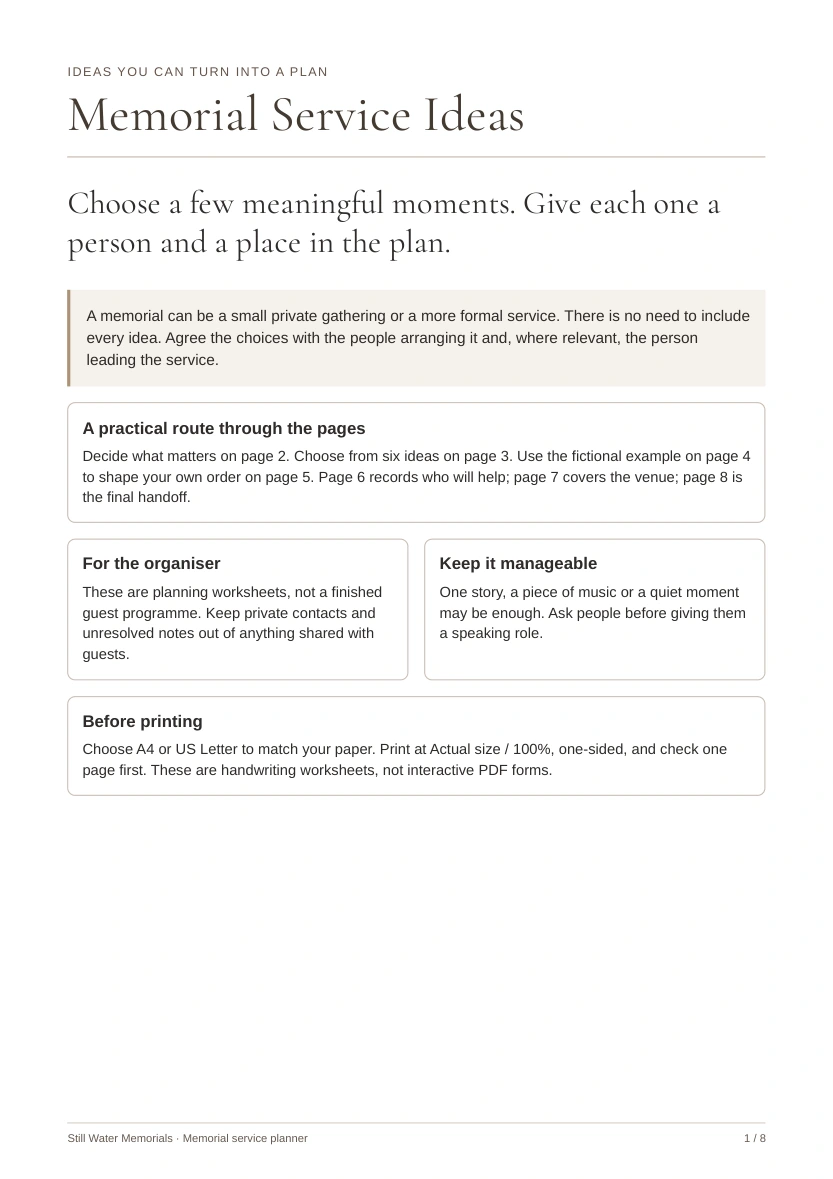
Many families build their program around the life-story structure above: name, dates, the order of readings and speakers, and a closing thank-you. If you'd like a starting point for organizing all of this, our memorial service ideas guide offers layouts and planning prompts that work for secular and religious families alike. You can also browse the full shop if you'd like printable options for programs, cards, or keepsakes.
A service built this way isn't missing anything. It's simply built from the person's own life instead of a shared text, and for many families, that ends up being the part people remember most.
A printable to help
Frequently asked questions
- Can you have a funeral without a religious ceremony?
- Yes. A funeral or memorial can be entirely secular, with no prayers, scripture, or clergy, and still follow a clear structure that gives everyone a sense of closure.
- What do you call a funeral with no religion?
- Many families call it a celebration of life, a memorial service, or simply a secular funeral. There is no single required name, so choose whatever feels honest to the person you're honoring.
- Who leads a nonreligious funeral service?
- A family member, close friend, funeral director, or a hired secular celebrant can lead it. Some funeral homes have staff experienced in nonreligious services if you'd rather not ask a relative.
- Is it okay to include a moment of silence instead of a prayer?
- Yes. A moment of silence is one of the most common ways secular services give people a quiet space to reflect without using religious language.
- What readings work well for a nonreligious funeral?
- Poetry, song lyrics, letters, favorite quotes, or passages from books the person loved all work well. The only rule is that the words should sound like them.
- funeral planning
- secular funeral
- celebration of life
- no religion
- memorial service
- funeral wording
Related reading
- How to Write a Funeral Program When There Are Two FamiliesGuidance on funeral program wording for a blended family, with fair ways to list stepchildren, ex-spouses, and two sets of family names.
- How to Plan a Funeral When You Can't Afford to Take Time Off WorkA realistic guide to planning a funeral while still working full time, with a compressed timeline and tasks you can do on breaks or in the evening.
- How to Choose Funeral Readings From the Bible When You Don't Know Where to StartA simple guide to choosing bible verses for funeral service readings, with examples by situation and tips for reading them aloud.